


The Python programming language is a versatile tool that is widely expected from startups to the largest companies, for example in positions such as Business or Data Analyst, IT or Network Administrator, Network Engineer, Cloud Engineer, Data Engineer, Data Scientist and of course Software Developer.
If you work in one of these jobs – or want to fill such a position at a company – you won’t be able to avoid the Python programming language. No matter what programming languages you’ve learned so far, or whether you use that knowledge in your daily work, Python is an easy programming language to learn, whether it’s your first or your fourth.
There are many ways to measure the popularity and “success” of programming languages. The Python programming language is currently ranked 3rd on the Tiobe index and 2nd among GitHub projects.
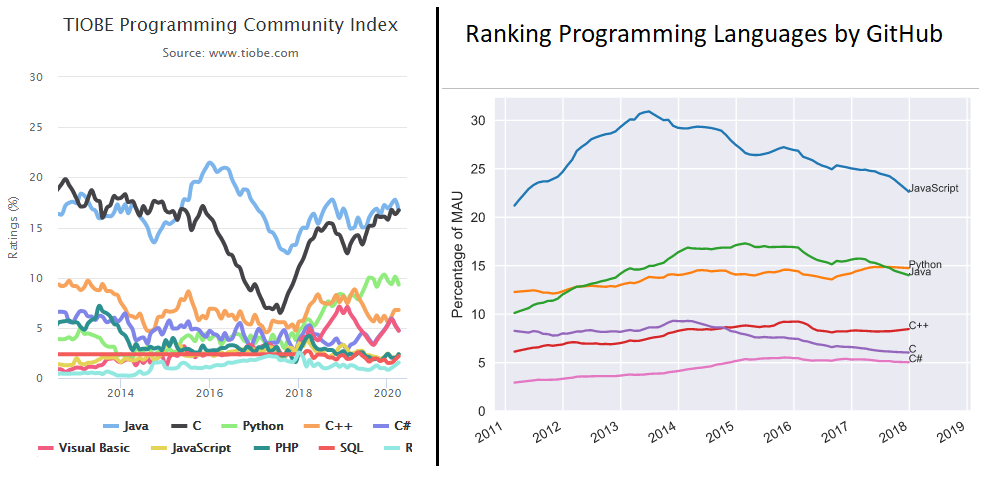
The Python community has been growing exponentially for many years. The language was designed to feel more natural to those who know at least a minimal level of English than its rivals, Java or C++.
print('Hello, Világ!')If this will be the first programming language you want to learn for your daily work, then Training360's practice-oriented Beginner Python training was created just for you.
Python is an object-oriented language, but thanks to its ingenious design, you don't have to struggle with this at first when learning the basics. In other languages, OOP is explained to you when you write your first program. That's why Python is easy to learn.
Python is a general-purpose programming language, so it can be used for everything from hobby electronics projects to academic dissertations to self-driving car models. Because it is a high-level language, it is easy to pick up the tools and students can start using them quickly. Because it is an interpreted language, it can be coded completely platform-independently, so our code will run the same on Linux and Windows, with a few exceptions.
There are areas where Python has become completely dominant. Such as Artificial Intelligence and Machine Learning. In the modeling branch of these areas, we can perhaps say that it has very few competitors, such as the much less widespread R programming language.
But Python is not the only tool in your toolbox that comes in handy in these areas. There are many times when you need to quickly automate manual tasks. For example, network administrative tasks are also easy to implement in it, thanks to the extensive community (Open Source) package system. There are countless packages supported by software and hardware manufacturers that can make your daily work easier and eliminate the need to perform manual and human error-prone tasks.
If you already have experience in another programming language or have already learned Python, but your professional goals include a deeper understanding of Python, you can gain an excellent foundation in Training360's practice-oriented Python intermediate training .
During the training, we focus on understanding various so-called Pythonisms, so that if you encounter them in code written by others, you will definitely be able to interpret them.
>>> strings = [ ['foo', 'bar'], ['baz', 'taz'], ['w', 'koko'] ]>>> [ (letter, idx) for idx, lst in enumerate(strings) for word in lst if len(word)>2 for letter in word][('f', 0), ('o', 0), ('o', 0), ('b', 0), ('a', 0), ('r', 0), ('b', 1), ('a', 1), ('z', 1), ('t', 1), ('a', 1), ('z', 1), ('k', 2), ('o', 2), ('k', 2), ('o', 2)]Such code snippets won't even make sense if you learn in detail how to use List Comprehension, for example.
Even if you already have concrete Python experience, there is still a lot to learn. You can use Python in countless Software Development jobs, even if the company you work for mainly relies on other technologies. Such areas could include developing small utilities, such as REST services. An excellent and quickly learnable package in Python for this is the Flask microframework.
from flask import Flaskapp = Flask(__name__)@@app.route('/hello/')@@app.route('/hello/<name>')def hello(name=None): return render_template('hello.html', name=name)The above little code implements a full-fledged Web Service. Concisely and clearly. However, there is a lot of Python language knowledge behind it, which these frameworks are built on. For example, Decorators, Jinja2 template system, http servers and clients, asynchronous programming, etc. It is possible to work with these frameworks without this knowledge, but it is not worth it. Isn't it better to understand how the tool in my hand works, rather than just hoping that if it looks like a hammer, it is not a road roller?
You can learn this and many other advanced things in Training360's practice-oriented Python Advanced training .
Whether your goal is to learn a new programming language for professional or personal reasons, we definitely recommend Python because it is general enough to be useful in any professional career, it is platform-independent and easy to learn. It also has a huge community of helpful and friendly people, and the tools are completely free, so they are immediately available to you, even within the framework of commercial activities.