

Is ITIL ® good for everything? Why didn't the creators logically name the latest update ITIL ® v4? Who do we recommend the latest version of the IT service management framework to? Our article will reveal.
The idea of a systematization of best practices that could significantly improve the quality of government IT services was first conceived in the UK's IT and telecommunications agency in the 1980s. The initiative eventually resulted in a catalogue of recommendations called the Information Technology Infrastructure Library. And although this is considered the ancestor of the ITIL framework still in use today, this long name has become obsolete over the decades and is no longer used at all.
The last major knowledge base update in 2019, the fourth major update, also saw the letter “v” used before the version number in ITIL v2 and v3. It may be surprising, but the reason behind the change is somewhat similar to the reason why the nearly forty-year-old name was shortened to an acronym: time has passed. Below, we provide an insight into what exactly this means and where the explanation for the change lies in the ITIL ® 4 system.
Spoken word play
The root of the change can be traced back to an English word play, the phrase “ITIL Four” sounds eerily similar to the phrase “ITIL For…”. The adverb “for” is often replaced by the number 4 in colloquial English for the same reason, its primary meaning being “for something, for something”. So when we talk about ITIL ® 4, we can actually continue this phrase in any way we want, for example: ITIL ® 4 Service Management, but it could also be ITIL ® 4 Banking, ITIL ® 4 Automotive, ITIL ® 4 Shipping, ITIL ® 4 Retail, etc. The range of possibilities is practically endless, and the word play serves exactly this purpose.
ITIL ® 4 is the first ITIL edition that attempts to interpret the application of good practices very broadly, and not only recommends ITIL ® practices for IT service management purposes, but also identifies them as interpretable and usable in practically any industry. The developers of the new version believe that there are many ITIL practices that can also stand outside the IT world and can provide useful lessons for businesses that are engaged in completely different types of core activities. In the following, we will review two main aspects around which the authors of ITIL ® 4 try to justify the above statement.
The era of the digital economy
One of the frequently used new terms, which is already mentioned at the Foundation level in the world of the fourth ITIL version, is the 21st century as the era of the digital economy. Thanks to the brutal acceleration of digitalization, the world economy has changed at an unprecedented pace in the past decade or so, and with it the boundary conditions for success in the business sphere. Large companies have emerged from nowhere, new industries have been born, or existing giants have spectacularly collapsed because they were unable to keep up with the pace of change.
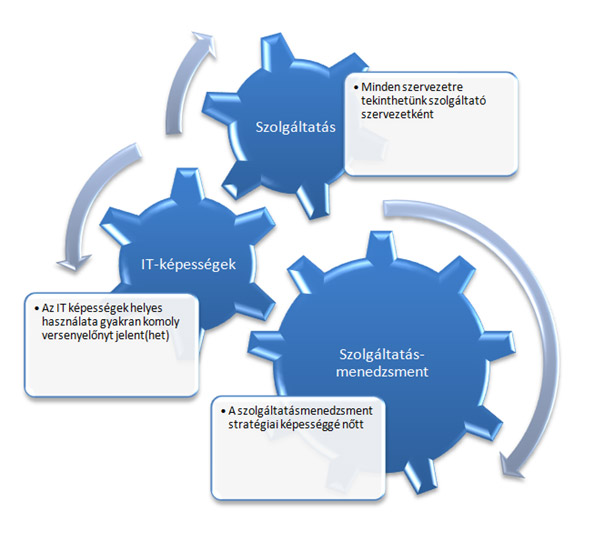
One of these preconditions is that nowadays - especially in light of the general consumer habits changing in the wake of the coronavirus pandemic - the existence of dedicated IT capabilities has become crucial in practically every industry and for every large-scale enterprise. What is more, their proper “putting into service” can be a serious competitive advantage. And IT service management in the narrow sense considers the effective use of precisely these capabilities as its primary goal. Based on this, we can confidently state that service management is an essential strategic capability for every enterprise in the era of the digital economy.
He who provides creates value.
Another important paradigm shift in the fourth edition of ITIL ® is that it opens up and redefines the concept of service. Since 2019, the definition of service and service management in ITIL language has been primarily built around the basic idea of value creation, while we do not find any narrow references to the world of IT.
Based on the above concept, we can consider practically every organization, with a wide variety of activities, as a service provider. From classic service providers, such as healthcare or telecommunications providers, through services integrated into our everyday lives, such as delivery from the corner pizzeria or employee-free checkouts in the supermarket, to manufacturing companies, such as manufacturers of electronic devices or vehicles.
The latter can be considered service providers not only because of their internal services within the organization, but also because they have realized that if they sell their products together with services, they can earn long-term, recurring revenue and serious brand loyalty. However, to do this, they need to be able to manage services more efficiently than ever before, for which the ITIL ® system can be an excellent crutch.
ITIL ® has outgrown the IT world
One of the novelties of ITIL ® 4 is that it changes the central idea of ITIL ® : it “opens up” the world of ITIL ® , adapting to the way in which accelerating digitalization opens up new horizons for companies operating in many different industries. The system tries to make good practices interpretable for the world of services outside of IT, so that its users can simply benefit by selecting and applying the right practices. The end result, ideally, will be more efficient value creation and improved competitiveness of the given organization.
And what good and bad examples could be given from outside the IT world for the above? In our ITIL ® 4 Foundation course, we illustrate the importance of having service management through specific examples, introduce you to the new approach to previous ITIL processes, and lay a new foundation for continuous improvement as an important component of the service value system.