


Rapid response driven by increasing competition and market demand is critical for companies. From an infrastructure perspective, the focus has clearly shifted from on-premise solutions to cloud-based architectures in recent years. By expanding to the cloud, operational costs can be optimized, solutions can be elastically scaled, disaster recovery and high availability can be easily improved, information security, compliance with various regulations can be more easily tracked, and the list of benefits goes on and on.
On the other hand, the use of the cloud can also facilitate the application of methodologies related to the development of digital solutions – which have changed significantly in recent years – especially for software applications. We are talking about a transformation that results in, among other things, faster time-to-market of services, more frequent, even automated releases, real-time monitoring and testing, and immediate adaptation to changing needs. Achieving this result requires close cooperation between development and operations teams – this is where DevOps comes into play.
What are DevOps and the cloud?
DevOps, as a result of technological developments in recent years, primarily provides methodological solutions for the more efficient and transparent operation of complex systems that change frequently and quickly. DevOps is not a standard or framework, but rather the conscious and appropriate combination of several different building blocks – ITIL, Lean, Agile – into a single unit. It supports automation, continuous service deployment, and encourages a culture of collaboration and learning within the organization.
To better understand the intertwining of the two areas, in addition to the above definition of DevOps, let's first understand the cloud itself. According to the NIST definition, a cloud system has the following characteristics:
- Self-service: Users can use the infrastructure, platform, and other services offered by the service provider without the help of the service provider.
- Network access: Cloud services are accessible via the network in a standard way.
- Resource management: The cloud provider combines the resources it uses, combining them with different physical and virtual resources - dynamically allocating and reallocating them - to serve needs.
- Flexibility: Services can be quickly scaled and adapted to needs.
- Measurement: The cloud provider automatically monitors and optimizes resource usage at the appropriate level for the type of service (e.g. storage, processing, bandwidth), this resource usage can be tracked, controlled and reported.
The intersection of DevOps and the cloud
If we place the elements of the above definition next to the goals and operating model of DevOps, we immediately see the connection points that ultimately result in value creation on both the service provider and the user side. Below – without claiming to be exhaustive – we would like to highlight a few:
One of the most important elements of DevOps is that development and related infrastructure activities go hand in hand. This means that the configuration of the infrastructure itself is also part of the code, or in other words, infrastructure as code. If we add automation to this, one of the basic DevOps principles, we have come to the conclusion that its smooth implementation is almost impossible without the cloud, since the automated, scale-out creation of the infrastructure is more reliable and therefore produces better performance.
A direct consequence of this is that using cloud-based resources, identical environments can be easily and automatically created, thus practically eliminating the possibility of errors arising from differences in environments: all issues and bugs can be handled in the development or test environment before going live. Testing environments can be created simply and quickly without the costs and administration of physical hardware, and automated tests can be performed in a simulated environment indistinguishable from the live environment.
It is important to mention that all this can help DevOps team members to focus on their tasks, as they can get rid of monotonous tasks and thus devote their resources to activities where their expertise is really needed.
DevOps, by its very nature, can be truly effective through cross-functional, self-organizing teams. The self-service nature of the cloud can encourage teams to implement DevOps practices independently.
A fundamental element of DevOps is measurement, the results of which are continuously fed back. Measurement and monitoring not only help achieve effective results, but also help troubleshoot problems or implement preventive measures. With the help of the cloud, measured data is more easily accessible to collaborators.
The structure and architecture of applications have also undergone significant changes in the past decade(s). Microservice-based architecture has come to the fore, along with containerization, which together can create services that can be quickly built, elastically scaled, and easily administered, while also requiring high availability and fault tolerance. This is difficult to achieve without the cloud.
In the spirit of full interoperability, each public cloud provider also offers DevOps services, so that application lifecycle phases and cloud resources can be efficiently managed on the same platform.
Azure DevOps key features
Microsoft has placed great emphasis on the development and promotion of cloud services in recent years, thus gaining an increasing share of the public cloud providers and services market.
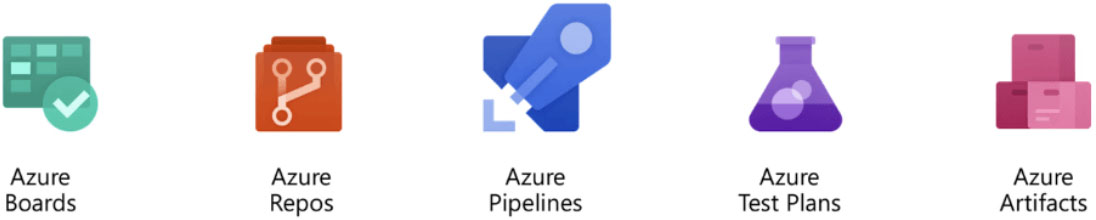
Below is a brief overview of Azure DevOps services:
- Azure Boards: is used to plan and manage development tasks. Requirements, user stories, epics, along with estimates, are recorded here. This is where we manage sprints and get a real picture of completed and remaining tasks.
- Azure Repos: a distributed version control that also supports various other version control systems (Azure Git, GitHub, GitHub Enterprise, Microsoft Team Foundation Version Control).
- Azure Pipelines: enables Continuous Integration and Continuous Delivery. Separate Release pipelines can also be created, which can also perform automatic deployment to production environments using appropriate gatekeepers.
- Azure Test Plans: is responsible for planning and executing manual and automated test cases, and creating test reports. Most importantly, it provides immediate feedback on the work done so far.
- Azure Artifacts: manages private NuGet, npm, Maven, Python packages, accessible from integrated development environments in a standard way.
When implementing DevOps practices, teams can quickly run into the problem that if the runtime environment or platform is not available at the right time, all automation processes stop.
Looking at it from this perspective - and returning to the beginning of the thoughts - one of the homework tasks to be completed during digital transformation is to find bottlenecks and effectively address them.
Therefore, implementing DevOps practices and using the cloud to deliver resources faster and more efficiently can greatly facilitate organizations' digital transformation. Not to mention that public cloud providers offer hundreds of different services that can be used to build applications and make them more efficient.
We can safely say that DevOps and the cloud complement each other perfectly, and this collaboration leads to increased speed of implementation, thus faster time to market, and overall higher level of services.