



In our 4-part article series, we explore the differences between traditional and agile organizations, their challenges and benefits. First-hand, honest experiences.
I particularly like Gareth Morgan's writings on economics, organizational development, and leadership in general. I think it's very apt that he refers to the period between 1911 and 2011 as "the management century," based on Taylor's work.
Frederick Taylor and his student Henry Gantt transformed management along scientific principles, optimizing the operation of the workforce, efficiency and effectiveness (be careful, these two terms are not the same), essentially operating like machines. Among other things, they introduced well-functioning quality control and developed a project management culture.
Nothing better demonstrated its effectiveness than the fact that the Ford Motor Company, which was still insignificant in 1910, acquired no less than 60% of the world's automobile market in less than a decade. They did this thanks to three significant breakthroughs:
- Car assembly was reduced from 12 hours to 90 minutes,
- Prices were reduced from $850 to $300,
- Last but not least, they gave their workers competitive wages and enough time off to spend it.
What does traditional operation look like?
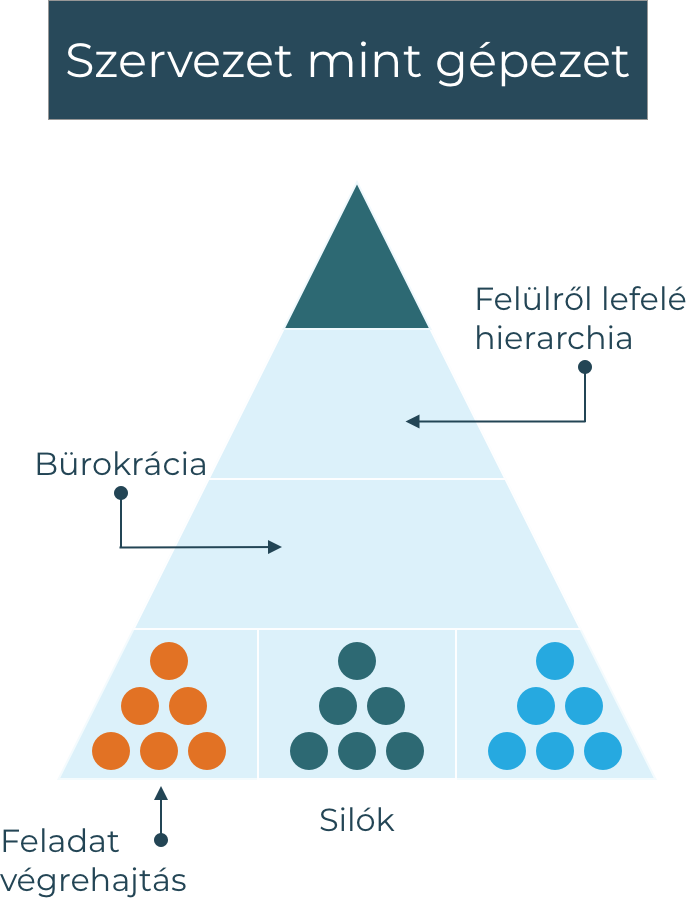
For the most part, the management of these companies is optimized for stability and predictability. Three important characteristics are worth highlighting:
- Their operation is static
- The workforce is organized into silos based on specialization
- Their hierarchy is clearly structured
Goals and decisions flow from the top down the hierarchy, with a powerful governing body at the top. Continuous smooth operations are achieved through linear planning and strong-arm management, thus creating value for their shareholders.
The skeletal structure of these organisms is typically very strong, which is advantageous in many situations. However, it can rightly be criticized for being very rigid and difficult to move in many situations.
In contrast, agile organizations
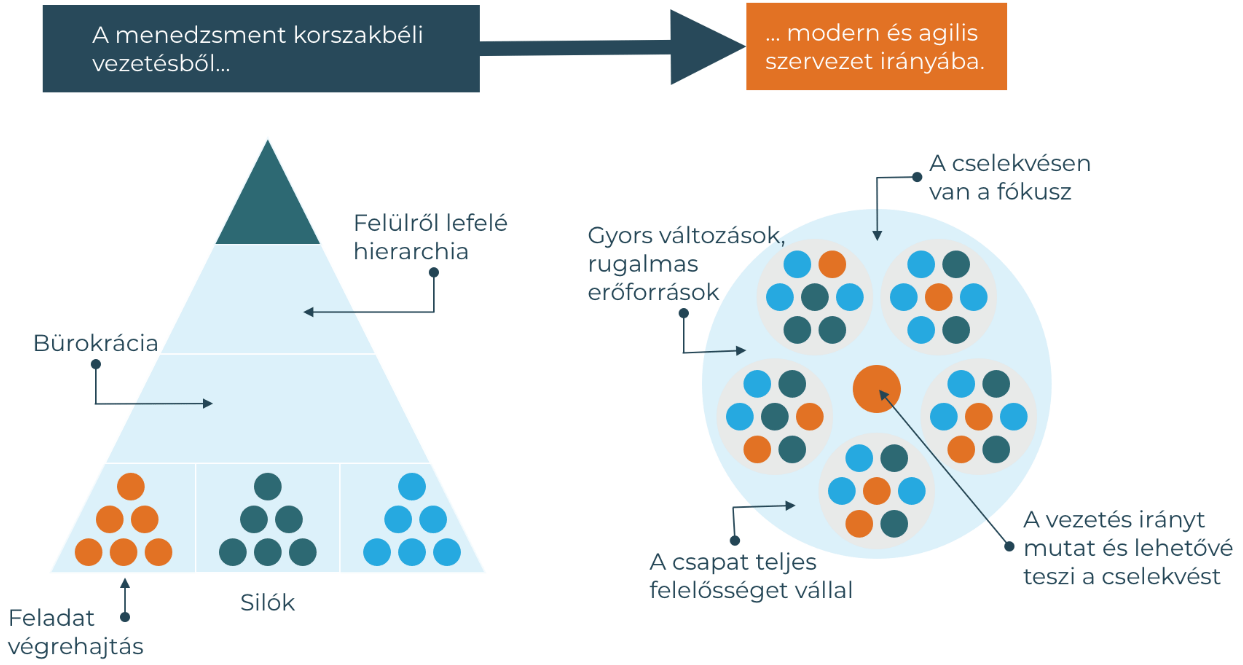
They are designed for both stability and dynamism, but the focus is different. The teams form a strong network, where the basis of operation is a human-centric culture. They are built on several core values:
- High-speed learning ability
- Fast decision cycles enabled by technology
- And all of this is driven by the common interest of creating value for the owners.
For example, startups are notorious for their ability to act quickly, but once they get beyond a certain point, they struggle to maintain that momentum. Similarly, large and established companies often become overly bureaucratic with their own rules, policies, and multiple layers of management.
This is an eternal trap that almost everyone falls into. Good decisions that previously supported economies of scale eventually begin to hinder rapid and efficient progress.
In our experience, truly agile organizations have paradoxically learned to be both stable (resilient, reliable, and efficient) and dynamic (nimble and adaptive). To master this, companies must carefully design their structure, processes, and governance rules, and do so with relatively unchanged fundamentals.
This operating model gives organizations the ability to quickly and efficiently redesign their strategy, structure, people, and technology, which creates opportunities for value creation and protection. Agile organizations bring the advantage of easier adaptation in uncertain and complex circumstances, in addition to stability.
Continued in part 2 of our Agile article series !
About Training360's agile training
The development of our renewed agile training portfolio was preceded by a thorough preliminary survey, so we offer a comprehensive educational solution for an extremely wide range of needs.
- Agile management training courses are available for all levels, from beginner to advanced.
- In addition to traditional agile methodology training, we also cover gap-filling topics such as digital product management, app management, or UX/UI.
- Employees, middle managers, and senior managers can all find training courses that are relevant to them.
- Not only members of development teams, but also product managers, salespeople, or HR experts can get a good idea of agility.
- Many courses also prepare you for internationally recognized exams.